Our tasting notes
89. Speyburn Clan Germany Tasting 25.09.2026
Hankey Bannister 12 Jahre – 40 % – 1 Liter (Whiskybase ID: 64389)
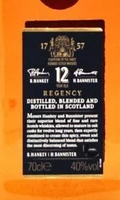 Nose: Visually, the Hankey Bannister makes a good first impression, though the question quickly comes up at the table whether we might suspect a little help with the colour. On the nose, it opens surprisingly fruity. Pear is clearly present, joined by caramel and lemon. After that, the aromas become harder to pin down. The wood first seems somewhat bitter, but on closer inspection it’s more sour. Then a cheesy note emerges. Old gym socks come up as a comparison, and unfortunately that isn’t far off. There are also fresh wood shavings. Not old oak, but more like what you’d find on the floor next to a circular saw. At the same time, the whisky feels pleasantly oily. A bit of grain is noticeable too, but it doesn’t get in the way at all. Not much happens after that. Even after an hour and a half, it barely develops. The Hankey Bannister shows fairly quickly what it can do, and then reaches its limits just as quickly.
Mouth: On the palate, it’s noticeably sweeter than the nose would suggest. Caramel and caramelised sugar dominate the start. Then come gentle pepper and, surprisingly, a faint hint of smoke. At the table, someone compares it to Highland Park: maybe a quarter of its smoke. That’s about right. The 40% ABV, however, is barely noticeable. It comes across as thin, and the finish is very short. No sooner have you started to engage with it than it’s gone again. Water only brings out a little more smoke on the nose. It doesn’t improve it, and at 40% there’s little reason to dilute it much further anyway
Comments: Uncomplicated and approachable – that sums it up pretty well. This is an easygoing whisky that won’t challenge anyone. It works neat, it’s unlikely to hold ice against you, and it probably wouldn’t put up much of a fight against cola either. That makes it a pretty decent summer, guest or entry-level whisky. At €26.95 a litre, you should keep things in perspective anyway. This isn’t some forgettable booze, and for us it’s clearly a step above what, say, a basic Ballantine’s has to offer.
The Caskhound Speyburn 10yo 57,5 % – Fully Matured PX Sherry Barrel (Whiskybase ID: 295969)
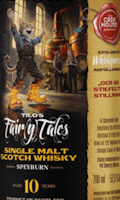 Nose: First impression: cheese puffs. And not even particularly good cheese. There’s also plenty of sharpness. That takes some getting used to and prompts the corresponding faces around the table. Interestingly, the nose changes noticeably with air and movement. After vigorous swirling, the cheesy note gradually disappears. Sherry, wood and herbs come forward. At the same time, the pepper gets stronger. The more you move it in the glass, the peppier it gets. And then suddenly peach appears. Not natural peach fresh from the tree, but pretty much exactly Lipton peach iced tea. Artificial? Yes. But somehow good. With more time, tobacco, fallen leaves and mushrooms show up. Lovage, or Maggi, joins in, and you can even find a little salt. That’s a surprisingly broad range of aromas. Only one thing we search for in vain: Speyburn. Blind, probably nobody at the table would have recognised the distillery.
Mouth: On the palate, it arrives powerful and with plenty of pepper. Here it occasionally recalls sherry-matured official bottlings. Then the PX cask strikes. Plummy sweetness comes up, heavy, sticky and quite pronounced. This is exactly where, for us, the problem lies. Between the pepper and this massive PX sweetness, something is missing. More volume and wood could bridge the gap, but they don’t do so sufficiently. This creates the impression, in places, of a sweet little juice with lots of pepper, and at the back the PX hammer hits once more. This is not an old sherry style. There’s no dusty elegance or decades-long marriage of distillate and cask here. This is modern, powerful sherry with plenty of sweetness and pressure. It handles water surprisingly well. A lot of water, in fact. At some point there are three tablespoons in the glass and the whisky still has enough bite. With water it becomes fatter. On the nose, sherry and wood emerge more clearly, and on the palate a more bitter side develops as well. Interestingly, blind we would have placed it in the low 50s ABV range. It carries its 57.5% better than the first impression suggests.
Comments: Difficult, but by no means bad. Above all, we miss the transitions between the individual parts. Even so, it surprises positively, and for one of us it’s even the best cask-strength whisky of this kind he’s had in the glass so far. The value for money works too. And the label with the “Puss in Boots” distiller gets an extra point regardless. This is not an everyday whisky. A summer whisky, even less so. You have to want to drink it. More of a dram for a cold evening when you have time and want to engage with it deliberately. The only really clear criticism: neat, it’s simply too strong.
Speyburn 15yo 54.1% Old & Rare Platinum – Exclusively for the British Forces South Atlantic Islands (Whiskybase ID: 295450)
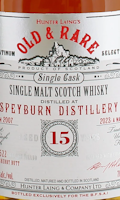 Nose: Right as it’s poured, something great happens: chocolate. Intense and immediately present. Unfortunately, this phase doesn’t last long. After that it turns cheesy. Even cheesier than the Caskhound. For an Old & Rare Platinum, it smells, at times, surprisingly difficult, to put it kindly. At the table, a less kind phrase is used. With time, cake and cookie dough come in. Sponge and a chocolatey base are slightly reminiscent of Black Forest gateau. There’s also a pasty sweetness and a faint whiff of cardboard. For a whisky from this series, alarmingly little happens at first. The alcohol is also more noticeable than we’d have expected. The deep colour suggests a first-fill cask, but a dark colour alone doesn’t make a great whisky. Air does help, though. As time goes on, it develops more depth and slowly begins to show why it ranks above the previous cask strength. But you really have to give it that time.
Mouth: On the palate, it redeems itself considerably. It tastes much better than it smells. The intensity is high, but not quite as brutal as with the Caskhound. The pear in particular stands out. And with that, there’s finally something where the connection to Speyburn is made fairly quickly at the table. Here the distillery is much easier to recognise. This whisky is certainly not terrible. We’re far from that. The problem is rather the benchmark. As soon as the label says Old & Rare Platinum and €159 is being asked, the air gets pretty thin pretty quickly. Water doesn’t help it.
Comments: The longer we spend with it, the better it gets. In the end, it clearly stands above the Caskhound for us. The question remains whether that’s enough for an Old & Rare Platinum. For €159 and with the reputation of this series behind it, we’d have expected more. A good whisky, certainly with depth and recognisable Speyburn DNA, but not what Old & Rare once promised.